
[MOOC] Narratives, news, and noise: AI, journalism, and the integrity of information
[MOOC] Narratives, news, and noise: AI, journalism, and the integrity of information25/11/2025
A new online course exploring AI, disinformation, and the future of truth in journalism
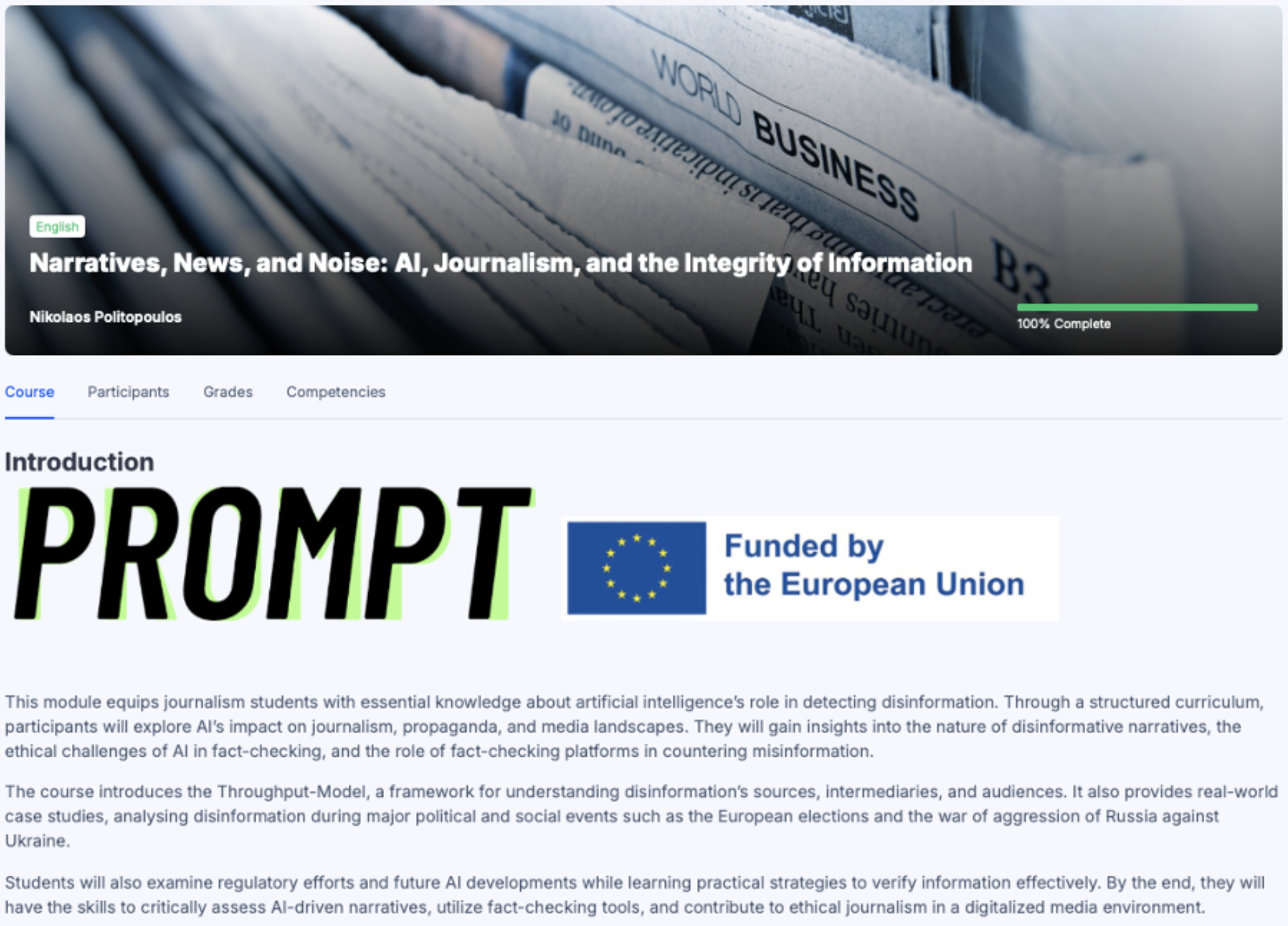
Artificial intelligence is reshaping how information is created, shared, and trusted. At the same time, disinformation spreads faster than ever – distorting public debate and undermining democratic values. Strengthening media literacy has never been more vital.
The new online module “Narratives, News, and Noise: AI, Journalism, and the Integrity of Information”, developed within the PROMPT Project and available on the COPE Training MOOC, equips journalism students and educators across Europe to understand how AI both drives and detects disinformation. This free, self-paced course invites participants to explore how false narratives are created, amplified, and countered - through real-world examples and critical reflection.
The COPE platform (Covering Cohesion Policy in Europe - Training MOOC) was developed by a consortium of journalism institutes from 27 EU countries to train journalism students and professionals across Europe on reporting EU issues. Built between January 2023 and June 2024 under TU Dortmund University, COPE provides 14 multilingual thematic modules, plus the module “Narratives, News, and Noise,” and offers a ready-made infrastructure for interactive, cross-border journalism education. Using this established MOOC platform allowed PROMPT to efficiently integrate its new module on AI, disinformation, and journalistic integrity.
What You’ll Learn
The module provides both conceptual foundations and practical insights, including:
AI’s dual role in spreading and detecting disinformation
Case studies from the Russian invasion of Ukraine, the Romanian elections, and anti-LGBTQ+ campaigns
The Throughput Model – a framework for analyzing disinformation flows
Fact-checking tools and journalistic strategies to navigate misinformation
Ethical dilemmas and evolving regulatory responses in the digital age
Whether you are a journalism student, educator, or simply someone who cares about truth in democracy – this module offers the tools to think critically and act responsibly.
Who It’s For
This module is designed primarily for:
Journalism and media students
Educators and journalism schools
Media professionals interested in AI and information integrity
Civil society actors and everyone engaged with digital media literacy
It can be completed independently or integrated into university courses and training programs as part of the broader COPE MOOC curriculum, which includes 14 modules - plus the new PROMPT module - on journalism, public communication, and European policy.
Pedagogical Approach & Integration
The module was designed to be both flexible and pedagogically grounded. Universities and journalism schools are encouraged to embed it into their curricula or use it as a stand-alone learning resource.
Its interactive structure combines theory with hands-on learning:
Analytical exercises for real-world cases
Reflective questions to foster critical thinking
Multimedia resources for independent study
Grounded in Bloom’s Taxonomy, the course builds progressively from understanding and analyzing disinformation to evaluating and applying critical strategies for ethical journalism in an AI-driven media landscape. By engaging with current disinformation dynamics and ethical challenges, the course supports journalism educators in preparing students for the complex realities of reporting in an AI-driven media landscape.
How to Join
Participation is free and self-paced. Follow these steps to get started:
Create an account on the COPE learning platform: https://cope.csd.auth.gr/
Go directly to the PROMPT Module: https://cope.csd.auth.gr/mooc/course/view.php?id=31
You can start anytime - learn at your own pace, explore the materials, and join a growing community of journalism students across Europe.
For questions, please contact Merle van Berkum from the Erich Brost Institute for International Journalism, TU Dortmund.